
 Alex from the Rock - Adobestock
Since January 2023, landlords have been required by the CO₂ Cost Sharing Act to cover a portion of the CO₂ costs. The amount depends on the building's energy efficiency and is distributed through the heating bill.
Legal obligation to share CO₂ costs
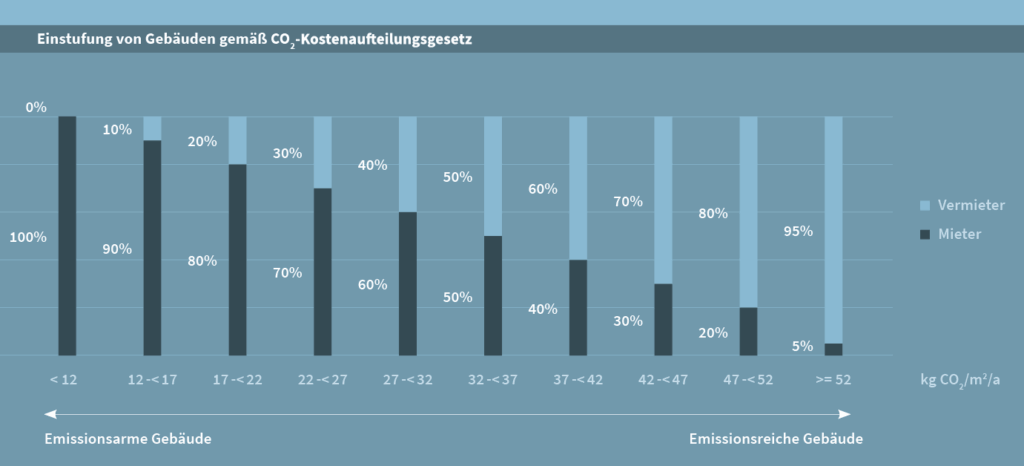
Until the end of 2022, tenants had to bear the CO₂ costs alone. Since the CO₂ Cost Sharing Act ( CO2KostAufG ) came into force on January 1, 2023, landlords have been required to contribute. The amount of the landlord's share depends on the building's energy efficiency standard. The worse the building envelope and heating technology, the higher the landlord's share of the costs. The legislator aims to create a financial incentive to invest in energy-efficient renovations and reduce CO₂ emissions.
This is how the CO₂ costs are distributed.
- 10-step model for residential buildings: Tenants and landlords share the costs according to the energy efficiency of the building. In very well-insulated buildings, the tenant can bear up to 100% of the CO₂ costs.
- Non-residential buildings: Currently, there is a 50/50 split, which is to be replaced by a phased model in 2025.
- Special regulations: If energy efficiency improvements are not legally possible, the landlord's share can be halved or completely eliminated. Examples include historic preservation regulations, mandatory connection and usage requirements, or preservation statutes.
Implementation of the CO₂ cost sharing law in heating cost billing
The owner is responsible for the building's zoning. The following data is required for this:
- CO₂ quantity and CO₂ costs from the energy supplier's bill
- Living space of the building, as this may differ from the area used in the heating cost statement.
Determining the required energy efficiency level is particularly complex for heating fuels that require storage, such as heating oil. Minol supports building owners by requesting the necessary information annually and calculating the required level. The cost share for each tenant is then distributed via the heating bill.
Rights and obligations
- Tenants' right to reduce rent: If the landlord's share or the required information is not provided, tenants can reduce their heating costs by 3% (§ 7 para. 4 CO2KostAufG).
- Option for homeowners' associations (HOAs): No legal division, but optional disclosure of the landlord's share in the statement of accounts is possible to facilitate the correct pass-through of costs for landlords within a condominium association.
Conclusion and recommendations
The implementation of the CO₂ Cost Sharing Act has been mandatory since 2023. Incorrect or missing information in the heating bill can lead to reductions by tenants. Landlords should implement the legal requirements precisely to avoid legal and financial disadvantages.
Suggestion:
- Collect all necessary data on the building and fuel costs in a timely manner.
- Check whether any special regulations apply to your property.
- Use professional billing services like Minol to ensure the correct calculation and legally compliant reporting of CO₂ costs.
Frequently Asked Questions

Which heating media are affected by the CO₂ cost sharing law?
For which time periods does the CO₂ cost sharing law apply?
How do I know if I am affected by the exemptions?
How are different building situations handled?
How should I proceed if only part of the building is a listed building?
Regulations for district heating connections after 01.01.2023?
Where can I find the necessary information?
How is CO₂ calculated?
How is the classification carried out according to the tiered model?
How is the classification into levels carried out for shortened time periods?
What are the standard emission factors?
How are CO₂ costs determined for heating media with storage?
Why was there no tiered classification for heating oil for the period 2023?
How is the cost divided among the tenant?
What happens if I don't comply with the legal requirement?
How is the living space determined or handled?
Why does the energy consumption on the gas bill differ from the energy consumption used for CO2 emissions calculation?
Handling of mixed heating media, e.g., bivalent heat pumps
Higher CO₂ costs for heat suppliers
Why are there no CO₂ costs associated with my service provider?
Special features of heat suppliers
What options are available for homeowners' associations?
Is the division of property within a condominium association subject to a fee?
How is it handled in the case of a decentralized energy supply, e.g., with a gas-fired central heating system?
How should the CO₂ costs of my property be divided between me as the landlord and my tenants?
 contrastwerkstatt – stock.adobe.com
Heating bill from a professional
Brunata Minol supports you with digital measurement technology and radio transmission and in providing interim consumption information via app – secure, digital and compliant with the German Heating Cost Ordinance (HKVO).
 InsideCreativeHouse – Adobestock
Always up to date
* required fields