
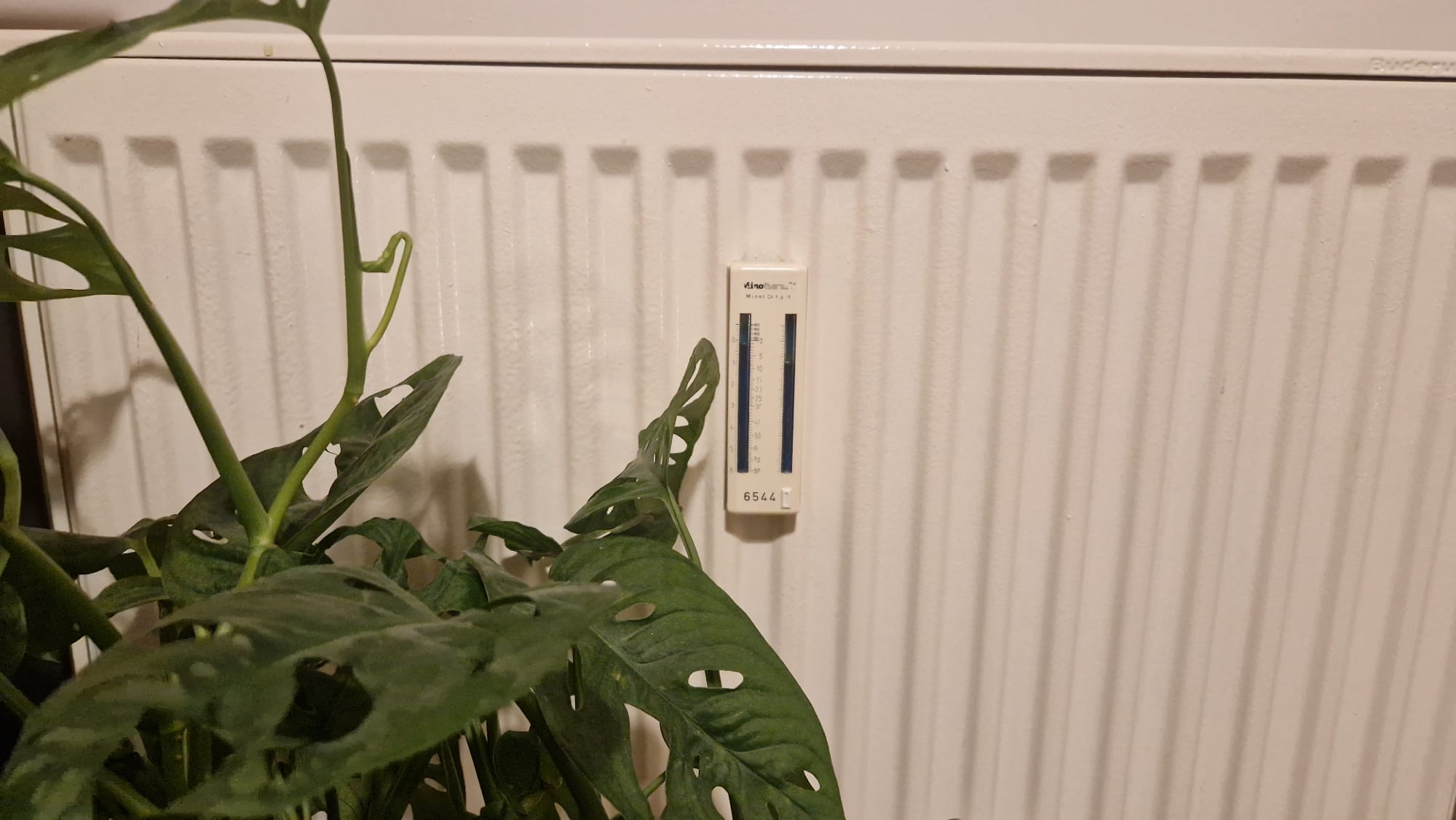
Control options and security for owners and tenants with Brunata Minol evaporative devices
Evaporator tubes are read according to fixed rules and are traceable thanks to dual scales and previous year's ampoules. Technical safeguards and control mechanisms ensure a very low susceptibility to errors.
Why do doubts arise when reading evaporator tubes?
Many tenants and landlords ask similar questions:
- Was the reading correct?
- Is the result plausible?
- Can I check the consumption myself?
Especially with evaporative heat cost allocators, rapid readings or unexpected additional payments often cause uncertainty. Minotherm II devices from Brunata Minol offer modern monitoring options in these situations.
 Jacob Ammentorp Lund – stock.adobe.com
You haven't modernized yet?
While evaporative heat cost allocators – so-called evaporative tubes – are still legally permitted, they have been increasingly replaced by electronic devices for years, nowadays with convenient wireless transmission of readings. From the end of 2026, wireless transmission will even be mandatory. Find out more now and upgrade to state-of-the-art technology. It's more affordable than you think!
This is how to read evaporator tubes (Minotherm II)
Evaporator tubes work on a simple principle: The measuring fluid contained in the tube evaporates depending on the heating power. The more heat is applied, the more fluid disappears – and the consumption increases accordingly.
Brunata Minol also employs several safety and control mechanisms:
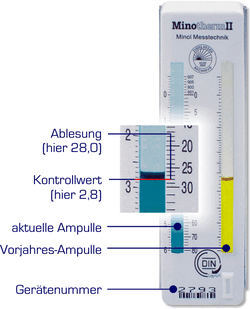
- Dual scale with control valueOn the left is a control value, on the right the consumption value, which is used for billing. Both are mathematically linked.
- Digital testing routineDuring data entry, the system directly checks whether the inputs are logically consistent. Incorrect entries are not accepted.
- Last year's ampoule in the viewing windowAfter the reading, the old ampoule is left sealed in the device and remains visible until the next reading.
- Unique device assignmentThe reading will only be stored in the system if user data, room designation and device number match.
This combination ensures that reading errors are virtually eliminated.
How do I correctly read an evaporator tube?
Even as a tenant or owner, you can carry out your own meter reading – if you observe a few important points:
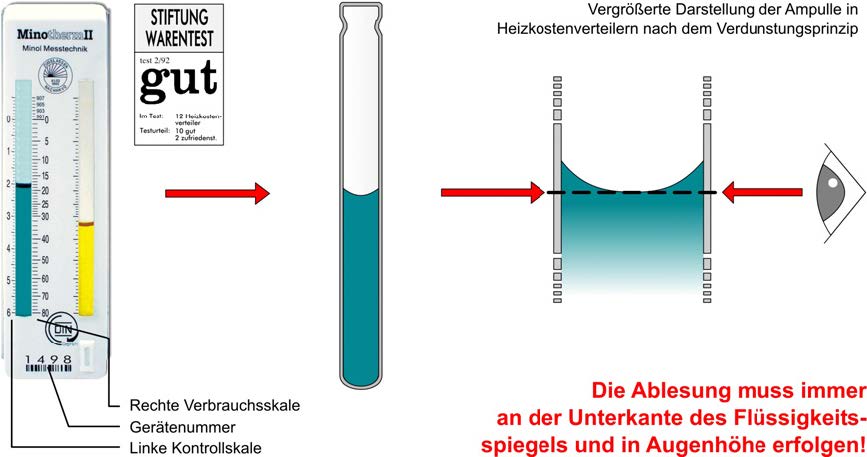
1. Read the measurement at the bottom edge.
The liquid in the tube bulges slightly. The crucial reading is taken at the bottom edge of the liquid column. Reading at the middle or top edge risks discrepancies of several units.
2. Read at eye level
Looking at the wrong angle leads to optical distortions (parallax errors). Therefore, the gaze must be directed straight ahead and at eye level.
3. Use a light source
Hold the tube up to a light source or use a flashlight. This makes the liquid level clearly visible and facilitates accurate readings.
4. Do not hold the tube at an angle.
The heat cost allocator should be held as vertically as possible when taking a reading. Holding it at an angle can distort the measurement result.
5. Consistent procedure counts
Professional meter readers work with practiced hands and in a consistent manner. This ensures fair and comparable meter readings – even if the method does not guarantee 100% accuracy.
6. Perform a self-check shortly before the appointment.
If you wish to check the reading yourself, do so one day before the official reading . This is the only way to ensure that the evaporation level and ambient temperature match.
What are the legal implications of a signed meter reading?
If a tenant signs the meter reading protocol or the digital receipt, the consumption value is considered accepted. Subsequent objections are only permissible if there is a demonstrable error – for example, in the case of incorrect allocation or a clearly identifiable misreading (see Berlin Regional Court, case no. 64 S 97/96).
The Brunata Minol dual-scale system
A key safety feature for reading evaporator tubes is the dual-scale system from Brunata Minol , which is integrated into the Minotherm II heat cost allocators. It ensures that every reading can be checked for plausibility immediately – both by service personnel and subsequently by tenants or owners.
Here's how the system works in detail:
- Two scales per device:
- Left scale (Li value) = Control value
- Right scale = actual consumption value for the heating bill
- Visual inspection: The two values must be on one horizontal line If you are unsure, you can use a simple ruler to check whether both markings are horizontally aligned. If they are not, there is probably a reading error.
- Device testing during data acquisition: When entering the data, the meter reader not only enters the consumption value, but also the device number including the check digit. The system only accepts the entry if all data matches exactly.
- Software-supported testing: After the reading is entered, the mobile reading device checks whether the control value and the consumption value are in the expected relationship. If not, the entry is rejected and a new reading is required.
- No chance of confusion: The system ensures that consumption values are not accidentally assigned to the wrong room or device – thus preventing a common source of error in manual readings.
This dual-scale system offers an additional level of security that goes beyond legal requirements and ensures maximum transparency in the distribution of heating costs.
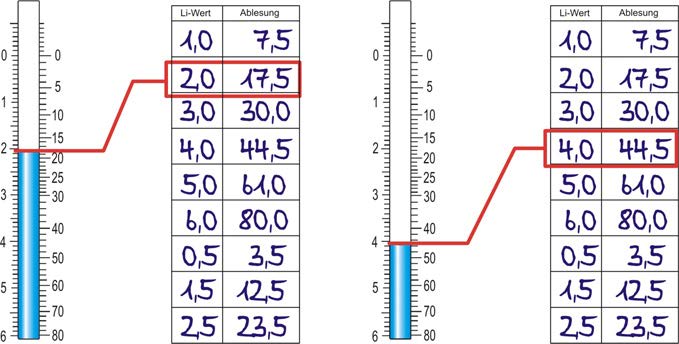
Reading and recording errors. This corresponds to a left control value of 2,0.
Only the right-hand consumption value of 17,5 is correct. Any other result would be incorrect.
and cannot be recorded by the meter reader.
Why is it still worthwhile to have your own checks?
- It provides greater security in billing.
- It can be easily performed without technical aids.
- It is helpful if questions arise regarding the billing.
Nevertheless, self-monitoring does not replace professional reading by trained service staff who read hundreds of devices daily and can react directly to deviations.
Conclusion: Reading from evaporator tubes is comprehensible and safe.
The combination of the previous year's ampoule, digital testing logic, and unambiguous device assignment makes reading the evaporator tubes on Minotherm II devices extremely reliable. Even with subjectively high heating costs, there are clear options for follow-up verification.
Recommendation: Switch to wireless heat cost allocators now.
While evaporative water meters are still permitted, they will be replaced by wireless technology from the end of 2026. Switching now is worthwhile – for greater convenience, accuracy, and future-proofing.
 InsideCreativeHouse – Adobestock
Always up to date
* required fields