
 ah_fotobox - stock.adobe.com
Information for operators of combined heat and power plants
Accurate billing for combined heat and power (CHP) plants is essential for landlords to correctly allocate heating costs based on consumption. This primarily involves considering fuel costs, the separation of heat and electricity components, and maintenance costs. VDI 2077 Part 3.1 provides binding guidelines for the measurement and calculation of these costs. Precise data collection promotes energy savings and ensures legal certainty.
Why is the billing of CHP plants important?
Combined heat and power (CHP) plants generate electricity and heat simultaneously. This efficient technology is often used in residential and commercial buildings to optimize energy consumption and reduce environmental impact. Landlords face the challenge of how to fairly and legally distribute the resulting costs among their tenants. The difficulty lies in correctly recording and allocating fuel and maintenance costs.
This is how billing for CHP plants works.
CHP technologies
1. CHP units with combustion engines
They generate electricity by burning fossil fuels such as gas or oil. The waste heat is used for heating.
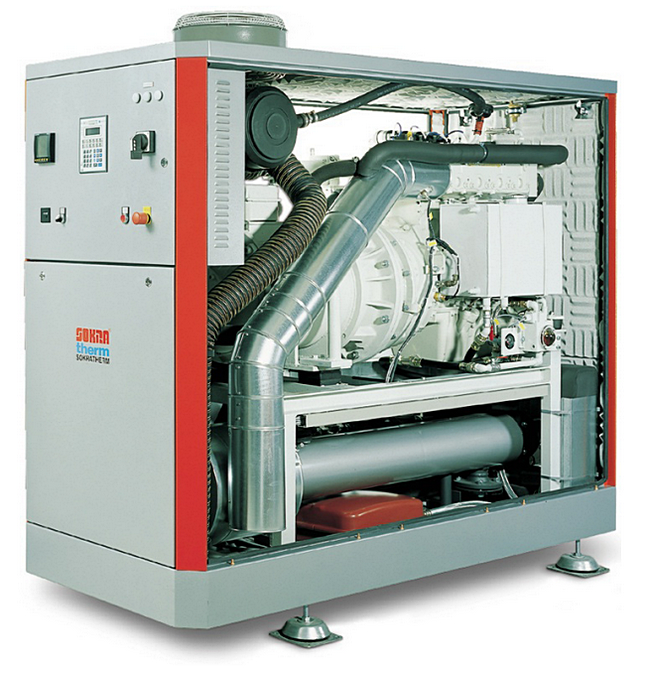
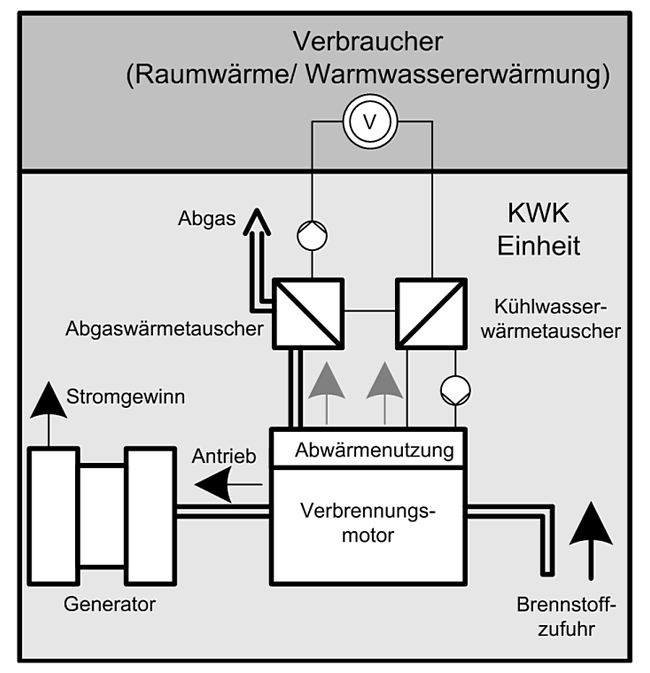
Compact CHP unit with combustion engine with side panel removed (photo: Sokratherm) and functional diagram of a combined heat and power plant based on the combustion engine principle.
2. CHP units with fuel cells
They convert chemical energy directly into electricity and heat through hydrogen reactions, without a mechanical generator.

Types and special features of CHP plants
- Non-modulating systems: They produce heat and electricity constantly according to fixed power values.
- Modulating systems: Dynamically adjust heat and electricity generation to meet demand.
Buildings with a combined heat and power (CHP) plant as the primary source of heat are not subject to the billing requirements of the Heating Costs Ordinance (§ 1 (1) 3. b). Nevertheless, consumption-based billing is sensible and highly recommended even for CHP plants, because it is the only way for homeowners and tenants to be more mindful of their energy consumption. It has been proven that only billing based on actual consumption motivates energy conservation.
Owners of a combined heat and power (CHP) unit are entitled to a refund of the energy tax (formerly mineral oil tax) upon application to the responsible main customs office, in accordance with the CHP Act. This amount must later be deducted from the total energy bill, as heating cost statements according to the Heating Cost Ordinance only permit the allocation of actual costs incurred. From the remaining total fuel costs, the portion used to supply the building with heating and hot water—the so-called thermal energy component—must then be allocated in the heating cost statement. The allocation of fuel costs incurred for the electricity generated by a CHP unit within the heating cost statement is not permitted.
Determining fuel costs correctly
The correct allocation of fuel costs between heat and electricity is carried out according to VDI 2077 Sheet 3.1. The VDI guideline distinguishes between two methods:
- Measurement method: For determining the apportionable fuel share in untested combined heat and power (CHP) plants, the metrological method is mandatory. The minimum required measuring equipment, i.e., fuel meters as well as heat and electricity meters at the CHP unit, for applying the appropriate metrological method depends on the specific design of the heating system and must be determined individually. The metrological method must be applied to untested CHP units.
- Computational method: In contrast, measured efficiencies are available for certified* combined heat and power (CHP) plants, enabling the calculation of the fuel consumption relevant for billing purposes according to the specifications of VDI 2077 Part 3.1. However, this calculation method should only be used in exceptional cases, as fuel, electricity, and sometimes even operating hour meters are still required. The only advantage is that the measurement effort can be reduced by eliminating the need for a separate fuel meter before and a heat meter after a CHP unit.
Experience shows that operators of combined heat and power (CHP) plants often face difficulties in recalculating the average electricity and heat efficiency figures annually. Minol therefore recommends the metrological determination method with the necessary minimum measuring equipment for tested and modulating CHP plants. This allows the respective efficiencies to be clearly determined.
Passing on maintenance costs
During the operating life of a combined heat and power (CHP) plant, higher maintenance costs are incurred compared to a standard boiler system. According to the VDI guideline, a plant-specific allocation factor must be calculated for the distribution of CHP maintenance costs. As a result, only a correspondingly determined portion of the CHP unit's maintenance costs may be included in the heating bill. So-called full-service contracts for CHP plant maintenance often include not only the maintenance costs that are generally eligible for allocation, but also non-allocable costs, such as those for repair work. CHP plant operators are advised to conclude separate contracts for maintenance and repairs so that the costs can be documented separately.
Conclusion: Billing for CHP plants – Transparent and correct billing ensures energy efficiency and legal certainty.
Billing for combined heat and power (CHP) plants requires expertise in both technology and law. Only by correctly determining fuel consumption and maintenance costs can a fair and consumption-based cost allocation be achieved. This motivates tenants to save energy and protects owners from legal risks. Minol advises its customers on the requirements of VDI 2077 Part 3.1 and is happy to provide recommendations for optimally defining the minimum metering equipment necessary for accurately calculating energy costs for heating bills.
Questionnaire for billing CHP plants: Data collection for customers: Questionnaire for billing CHP plants
Author

Quelle: Handbuch der Wärmekostenabrechnung | Frank Peters Minol Messtechnik W. Lehmann GmbH & Co. KG, 2019
 InsideCreativeHouse – Adobestock
Always up to date
* required fields