
 Rido - Fotolia - © Rido /
Heating and hot water bills are a necessary part of the operating cost statement – but they are rarely popular. Many users react with skepticism, especially when faced with additional payments. However, consumption-based heating bills offer significant advantages over a flat-rate allocation: studies show potential savings of up to 20 percent. In times of rising energy prices and increasing environmental responsibility, fair and transparent billing is essential.
Brunata Minol uses modern digital technology, standardized processes and decades of experience to ensure clarity and trust for landlords, property managers and tenants alike.
How does Brunata Minol's heating cost billing work?
The basis for every heating bill is the German Heating Costs Ordinance (Heizkostenverordnung) and the relevant DIN standards. These stipulate how consumption is to be measured, distributed, and billed. Brunata Minol prepares the bill for a typical residential building with central heating and hot water supply using a defined distribution scheme.
First, the total energy consumption of a building is recorded and divided into heating and hot water costs. This is then distributed into fixed costs and consumption costs – according to the legally prescribed allocation key. Each individual consumption value is recorded using modern, calibrated measuring devices. From these values, the individual shares that each resident has to pay are calculated.
At the end of the process, an easy-to-understand statement is generated, containing all essential information on two pages. The first page shows the result at a glance: credit or amount due. For those interested in the details, a transparent list of all measurements, cost categories, and calculation steps follows.
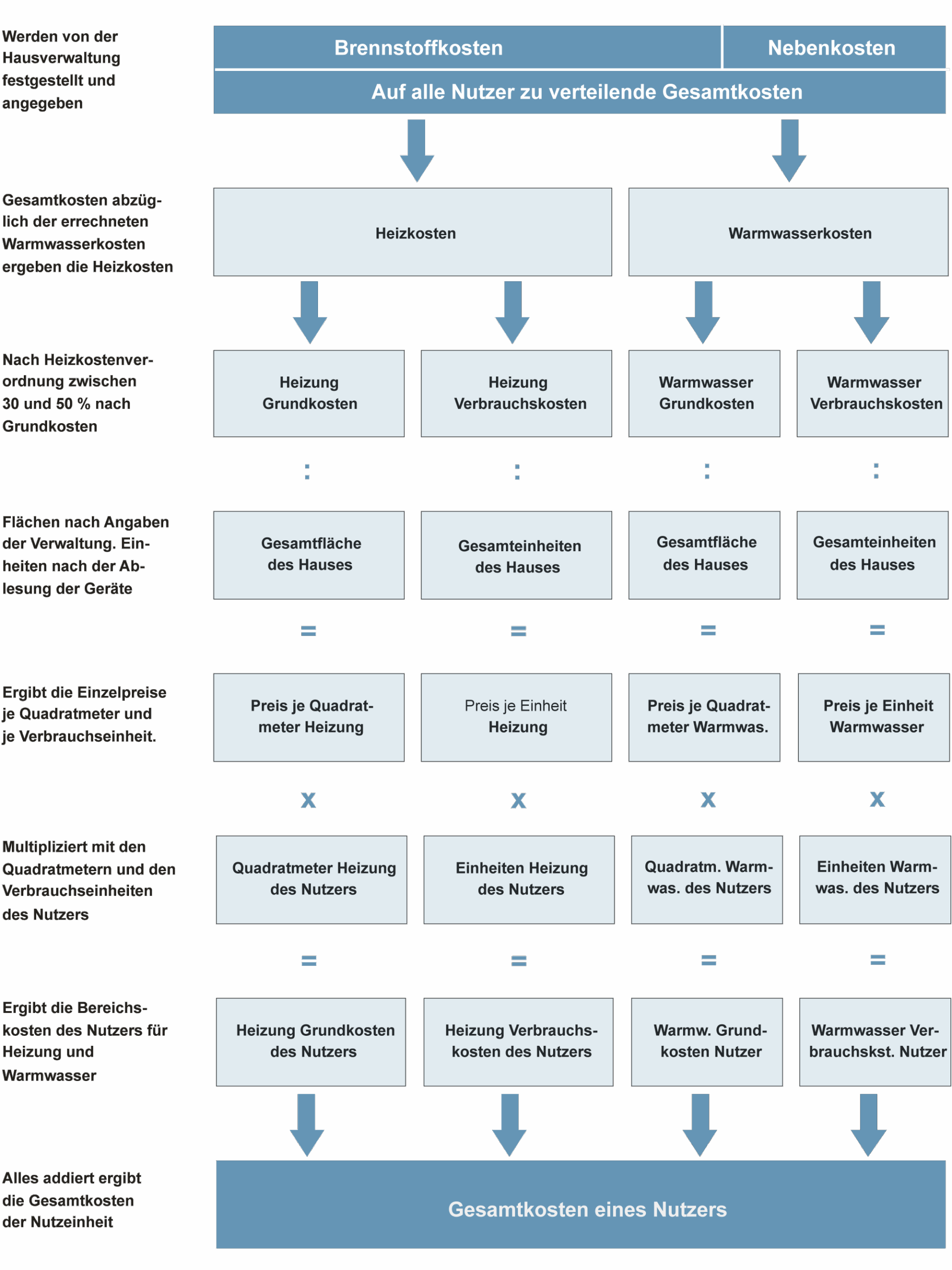
Seven steps to your heating bill
Using a typical building with central heating and hot water supply for four apartments as an example, the billing process can be explained in seven steps. The principle can also be applied to larger buildings.
What makes Brunata Minol's heating bill special?
Brunata Minol combines modern metering technology with reliable billing expertise. All processes – from consumption recording and cost allocation to the creation of user statements – are carried out according to the highest quality standards. Both property managers and residents benefit: Property managers receive a structured overall statement that allows them to review all data at a glance. Residents receive a transparent individual statement that clearly shows how their costs are calculated.
Another advantage is the digital remote meter reading via the Minol Connect system . This eliminates the need for manual meter reading in the apartment – increasing both convenience and accuracy. It also enables access to interim consumption data , further motivating energy savings.
The individual statement for apartment owners and tenants summarizes all the essential information. The recorded consumption figures are listed at the top, followed by the corresponding cost shares. The calculation basis for the unit prices used is explained on the following page in the overall statement for the building.
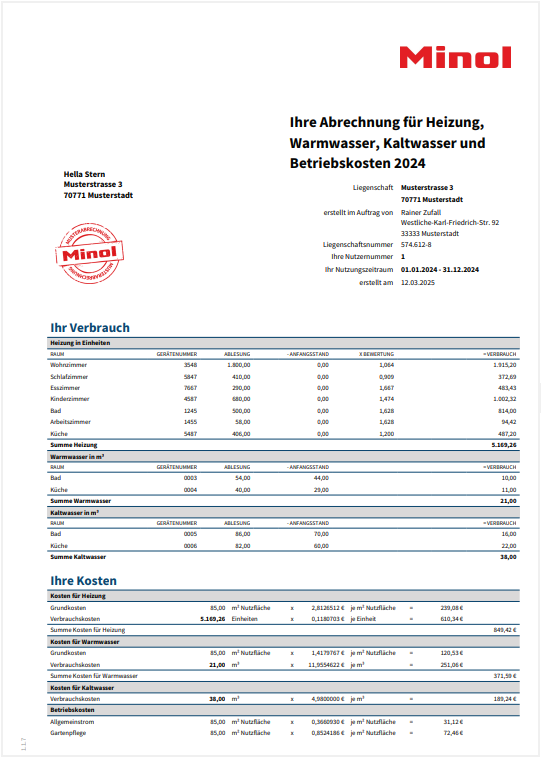
Area: Your consumption
The first part of the statement lists all metering devices relevant to the unit individually. The order corresponds to the device locations within the apartment, starting with the first room to the left of the apartment entrance and proceeding to the next room to the right. The last four digits of each device number are noted on the statement. If the devices have beginning and ending readings, the consumption is calculated from the difference. If devices were inaccessible or defective, the consumption was estimated, and the estimation method is explained.
Area: Your costs
Probably the most important part of the billing process. This is where the detailed breakdown of a user's costs is calculated. The previously determined consumption is multiplied by the cost per unit to arrive at the consumption costs. The same process is repeated for the basic costs, which are based on fixed criteria such as the apartment's size, volume, or ownership share, depending on the contractual agreement. Subtotals are calculated for all categories, and then totaled at the end. If the property management company has specified advance payments, the calculation determines whether there is a credit or a balance due.
Total building billing for all users
The overall statement shows the cost determination and calculation for the entire building. It details the total costs incurred by all residents during the billing period, how these costs are distributed across the individual areas, and how the unit prices are calculated.
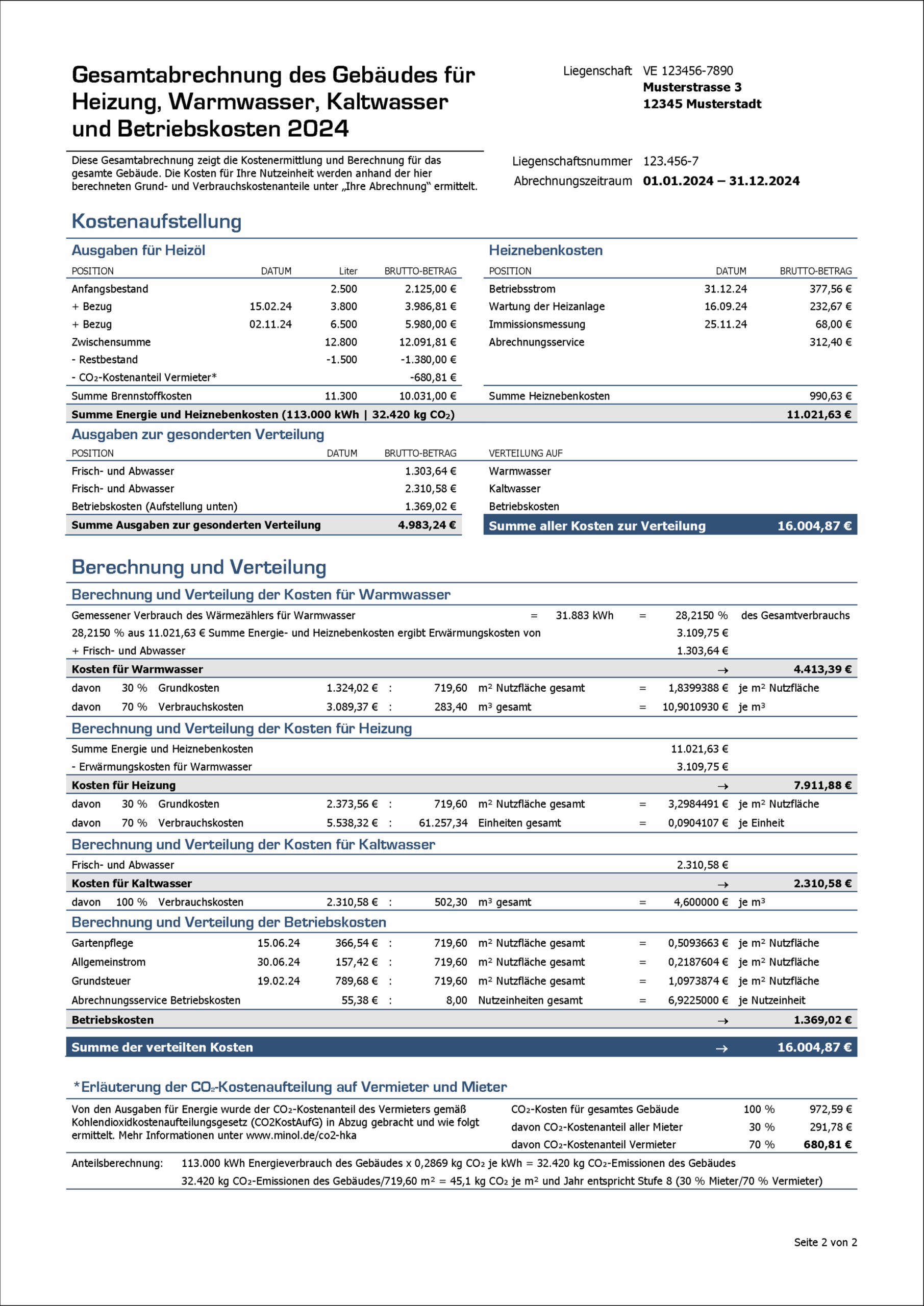
Section: Cost breakdown
The building owner or manager provides an annual cost statement detailing the energy and heating costs to be allocated to tenants. For energy costs, the invoices from district heating and gas suppliers are used. If oil or pellet heating systems are used, the corresponding individual deliveries are listed. Taking into account beginning and remaining stock levels, the consumption for the current billing period is calculated. This, combined with the listed heating costs, results in the total energy and heating costs to be allocated to all residents. Additional costs, such as cold water for hot water or other operating expenses, are listed separately for allocation.
Area: Calculation and distribution
Once the costs to be allocated for the billing period have been determined, the next step is to distribute them among the individual areas. Heating and hot water are usually supplied by the central heating system, so the first step is to divide the costs into these two categories. Various calculation methods exist for this, each of which is presented here along with all relevant factors. When the costs for hot water, heating, and other areas are established, the heating and hot water costs are allocated according to a predetermined distribution key into fixed and consumption costs. The price of a unit of heating or a cubic meter of water is calculated by dividing the building's area costs by the total consumption of all residents. The same applies to fixed costs, which—depending on the agreement—are divided by total floor area, total volume, or the total number of units. The individual prices determined here are used on each resident's individual statement to determine their share of the individual costs.
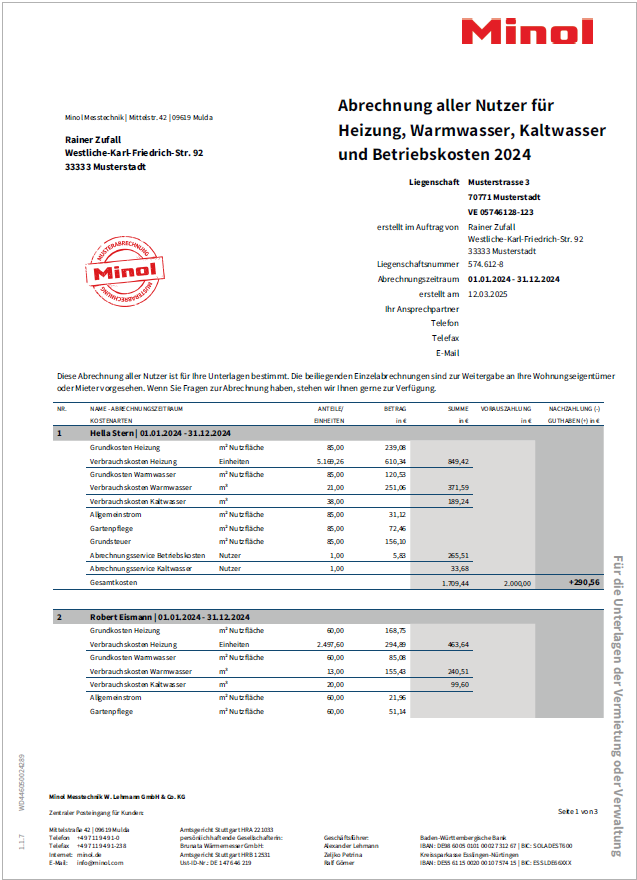
Billing for all users for administrators and landlords
The landlord and property manager receive a summary of all individual utility bills for each resident in the overall statement of accounts. This statement distributes all energy and utility costs listed for allocation among all residents.
Legal certainty and efficiency combined
Brunata Minol's heating bill meets all current requirements of the amended Heating Costs Ordinance. This applies not only to the technical aspects of consumption recording, but also to the obligation to provide regular consumption information and to present all calculations transparently.
At the same time, property managers benefit from a well-designed, digital system. The time and labor savings achieved through automated processes are considerable. Compliance with legal deadlines, the traceability of billing, and clear communication with tenants are thus significantly simplified.
Conclusion: Clarity, fairness and trust for all involved.
A precise and fair heating bill builds trust – especially when it's easy to understand and legally compliant. Brunata Minol offers the complete package: modern technology, clear presentation, and reliable billing. Having your heating bill professionally prepared benefits you not only from efficient management but also from more satisfied tenants.
 contrastwerkstatt – stock.adobe.com
Heating bill from a professional
Brunata Minol supports you with digital measurement technology and radio transmission and in providing interim consumption information via app – secure, digital and compliant with the German Heating Cost Ordinance (HKVO).
 InsideCreativeHouse – Adobestock
Always up to date
* required fields