
 Jacob Lund Photography - stock.adobe.com
A makeshift solution for determining heating costs with only one heat meter for a special consumer
Using heat meters to separate heating circuits is a computational workaround when not all heating circuits can be accurately measured. It is legally problematic, technically inaccurate, and should only be used in exceptional cases – for example, with special heating systems like underfloor heating when additional heat meters are unavailable.
Billing without complete measurement technology?
For accurate heating cost billing, the Heating Cost Ordinance stipulates that all consumers must be equipped with standardized metering technology. In practice, this means that each user group – for example, apartments with radiators or areas with special heating systems – must be recorded separately using heat meters or heat cost allocators.
But what happens if, for cost reasons, only a single heat meter is installed, for example for underfloor heating?
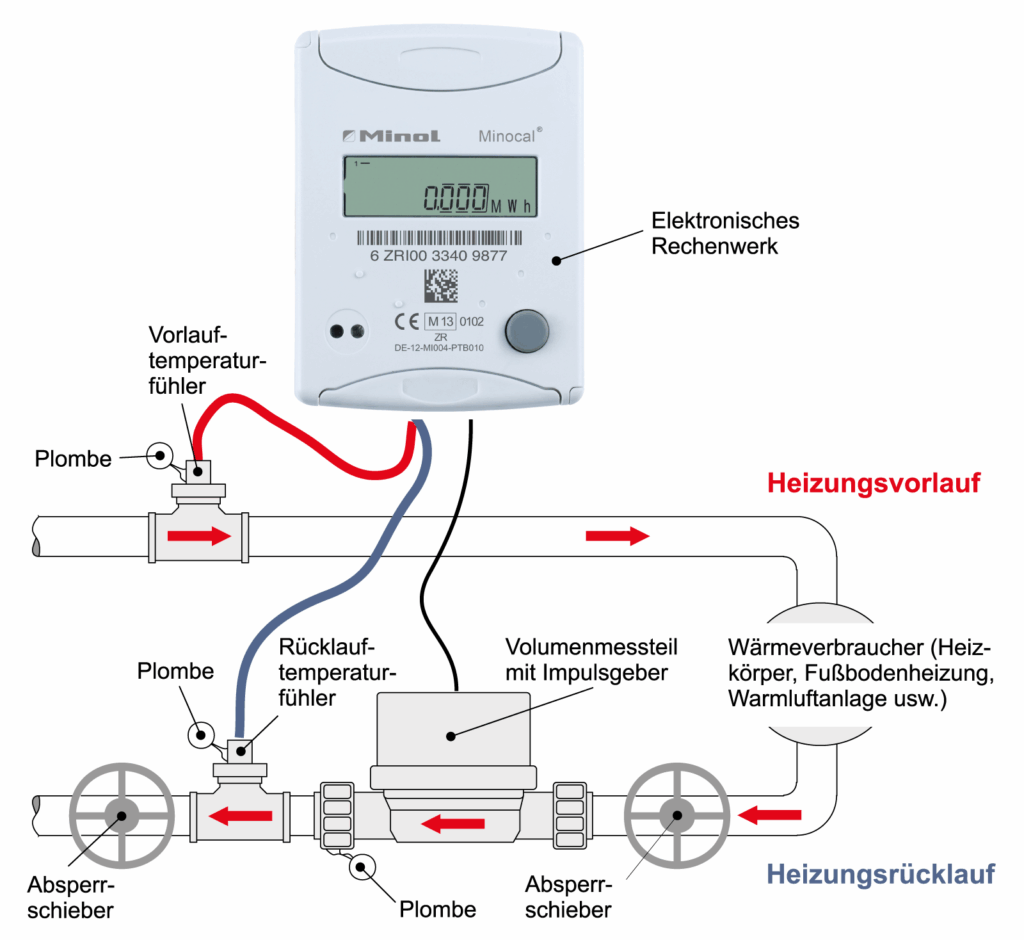
Formula separation: What's behind it?
In exceptional cases, owners or property managers resort to so-called formula-based cost allocation using heat meters. In this process, the heating costs for a specific consumption are calculated based on the following values:
Basis of the calculation:
V | = | Consumption according to heat meter in kWh |
Hi | = | Calorific value of the fuel used (e.g. heating oil = 10 kWh/l) |
VK | = | Share of consumption costs (according to the distribution key, e.g. 70%) Examples of distribution keys Basic costs to consumption costs: 50% CV: 50% CV = factor 0,5 30% CV: 70% CV = factor 0,7 0% CV: 100% CV = factor 1,0 |
0,8 | = | Average plant utilization rate of 80% for oil, gas and wood pellet plants |
€/BE | = | Fuel price per unit (e.g. €/l) |
Why is formula separation critical?
The method is problematic for several reasons:
- No legal basisIt is not enshrined in the heating cost regulations or DIN standards.
- Legally contestableAccording to the Federal Court of Justice (BGH) ruling, a separate heat meter must be installed for each user group (VIII ZR 57/07).
- ImpreciseThe standard utilization rate (80%) can vary significantly depending on the system.
- Permissible only if the cost share is low.If more than 10% of the total costs are distributed using the formula, it is no longer permissible.
When is formula separation allowed?
It is only considered a permissible exception if:
- the installation of an additional heat meter would be disproportionately expensive (e.g., extremely complex in terms of construction), and
- the proportion of special heating remains low (less than 10% of the total area or costs).
In these cases, the building owner can invoke Section 11 (1) HKVO , but must prove this in case of dispute.
Recommendations for landlords
- Avoid formula separation, if a technical solution using heat meters is possible.
- Document exceptions clearly, if you do use formula separation.
- Inform your tenants transparently about the calculation method used.
- Let us advise youe.g. through metering service providers such as Minol
Conclusion: Only precise measurement ensures legally compliant billing.
Using heat meters to separate energy consumption is an unreliable, stopgap solution that is neither technically nor legally ideal. Anyone wanting to play it safe – especially in the event of legal disputes or high costs – should opt for a complete metering system.
 contrastwerkstatt – stock.adobe.com
Heating bill from a professional
Brunata Minol supports you with digital measurement technology and radio transmission and in providing interim consumption information via app – secure, digital and compliant with the German Heating Cost Ordinance (HKVO).
Author

Quelle: Handbuch der Wärmekostenabrechnung | Frank Peters Minol Messtechnik W. Lehmann GmbH & Co. KG, 2019
 InsideCreativeHouse – Adobestock
Always up to date
* required fields