
 Song_about_summer - stock.adobe.
To avoid legal disputes with tenants, landlords should calculate the monthly advance payments for heating, hot water, etc. as accurately as possible.
With rising base rents, operating costs are increasingly coming into focus for tenants. At the latest during apartment viewings, prospective tenants ask about these "second rent" costs. Accurately forecasting the monthly advance payments for heating and cold operating costs is important for landlords – firstly, to cover the ongoing costs of the building, and secondly, to avoid large additional payments for tenants and subsequent legal disputes. The following points are relevant in this regard:
The legal basis
According to Section 556 of the German Civil Code (BGB), landlords and tenants can agree that the tenant will pay additional utility costs on top of the base rent and make advance payments for these costs. Both parties must record this agreement in the lease. According to Section 556, Paragraph 2, Sentence 2 of the BGB, advance payments may "only be agreed upon in a reasonable amount." Should the amount of the agreed advance payment subsequently prove to be too low or too high, Section 560, Paragraph 4 of the BGB states that "each party to the contract may, after receiving a statement of account, adjust it to a reasonable amount by providing a written declaration." This right to adjust the payment can therefore only be exercised after a statement of account has been issued.
Relevant court rulings
If a landlord deliberately sets the advance payment too low to make an apartment or house more attractive, some courts have interpreted this as deception and awarded the tenant damages (e.g., Karlsruhe Regional Court, Case No. 5 S 339/97; Berlin Regional Court, Case No. 64 S 109/01). A landmark ruling by the Federal Court of Justice (BGH) in 2004 strengthens the landlords' position: it is not a disadvantage for the tenant if the landlord demands advance payments that are "not only slightly, but also significantly below the actual costs." Damages are only considered if the landlord "expressly assured the tenant of the appropriateness of the ancillary costs or deliberately set them too low" at the time the contract was concluded. According to the BGH, it is not excessively low advance payments that are prohibited, but only those that are excessively high with the intent to deceive (BGH Case No. VIII ZR 195/03). The tenant must therefore prove the intent to deceive.
What affects consumption
The cost of space heating depends on the following factors: the apartment's location within the building (top-floor apartments consume by far the most energy), the building's age, the condition of the heating system, and the apartment's size. Climatic conditions (e.g., frosty or mild winters) also play a role. Furthermore, the cost depends on the heating medium (oil, gas, district heating, etc.) and the prices charged by the regional energy supplier. The newer and better insulated a building, the lower the space heating costs. However, hot water costs remain relatively constant because residents still cook, shower, and bathe in new buildings. This means that hot water costs in new buildings don't increase in absolute terms, but rather as a percentage, and nowadays can account for up to half of total heating costs. Even though tenants cannot influence factors like energy prices or thermal insulation, their individual consumption habits significantly impact their own heating costs.
Calculating the advance payments
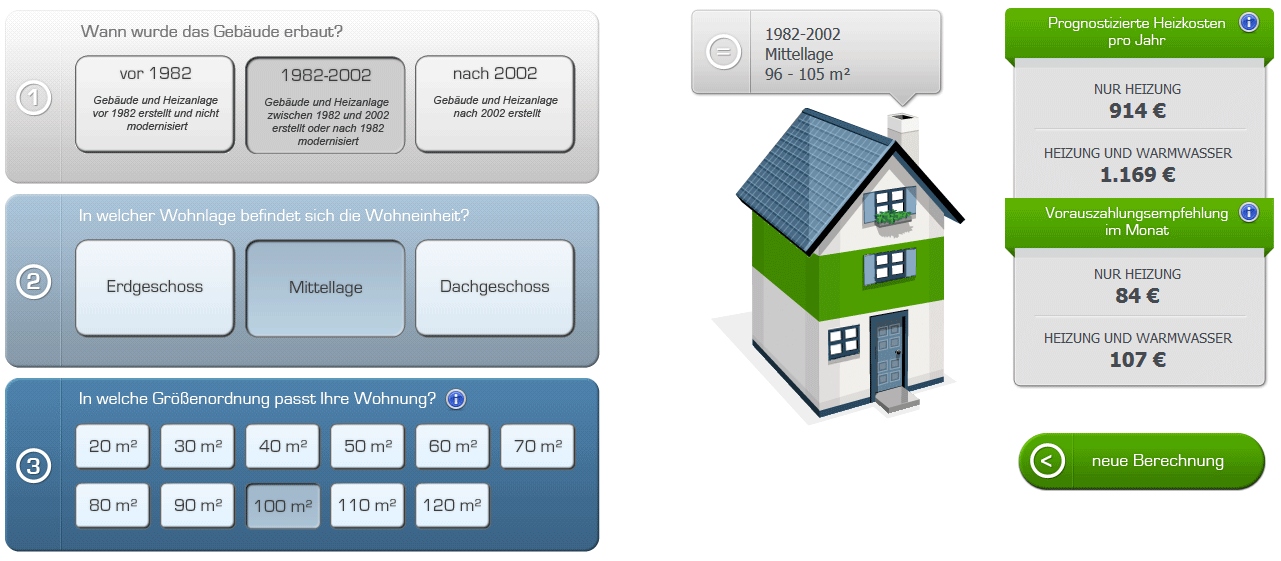
How can landlords realistically estimate monthly utility prepayments? Those with prior rental experience can refer to previous heating and utility bills for the building or apartment. First-time landlords have no point of comparison. Utility and heating cost comparisons, regularly published by the German Tenants' Association (Deutscher Mieterbund), offer initial guidance. Brunata Minol offers a new tool for determining prepayments for heating costs: its online heating cost forecast. After selecting the building's year of construction, apartment size, and location within the building, the expected heating and hot water costs are displayed: an average annual consumption figure and a recommended monthly prepayment, which includes a small safety margin to ensure tenants don't have to pay anything extra under normal heating habits. Because the calculation considers various parameters and is based on the statistical analysis of approximately 1,6 million heating bills annually, it provides practical figures.
Author

Quelle: Handbuch der Wärmekostenabrechnung | Frank Peters Minol Messtechnik W. Lehmann GmbH & Co. KG, 2019
 InsideCreativeHouse – Adobestock
Always up to date
* required fields