
 Monkey Business - stock.adobe.com
Everything you need to know about the mandatory installation of heat meters to measure the energy share for hot water in central heating systems
For heating systems with central hot water preparation, the energy consumption for hot water must be measured using a heat meter. An additional heat meter for measuring the heating circuit is recommended for technical reasons.
Until 2013, determining the energy share for hot water in the annual heating bill was achieved by measuring the total amount of hot water consumed using a cold water meter in the boiler's inlet. Alternatively, the sum of the individual apartment water meters could be used. Since 2014, for heating systems with central hot water preparation, the energy share for hot water must be measured using a dedicated heat meter. This is required by Section 9, Paragraph 2 of the Heating Costs Ordinance, which has been in effect since 2009. If a heat meter is missing, it must be retrofitted. Read on to learn what needs to be considered and what the consequences of a missing heat meter are for the heating bill.
The regulation aims to achieve a more precise allocation between heating and hot water costs. It also takes into account the increased share of hot water preparation in the overall heating system costs: stricter building regulations, energy-efficient renovations, and residents' energy-saving measures have led to a steady decrease in average energy consumption for space heating over the years, while hot water consumption remains relatively constant and thus increases as a percentage. While the calculation methods according to Section 9 of the Heating Costs Ordinance provide good approximations, only a heat meter can precisely determine the energy share for hot water.
A second heat meter for heating is recommended.
The requirement in the Heating Costs Ordinance for a heat meter to determine the energy share for hot water is insufficient from a technical standpoint and is hotly debated among experts. For a technically sound allocation of total energy costs between heating and hot water, a separate heat meter for the heating component is necessary. Without this second meter, the energy share for heating must be calculated by subtracting the measured energy for hot water from the total energy consumed. However, in this differential measurement, the measurement tolerances of the meters and the operating losses of the heating system are only factored into the share for space heating.
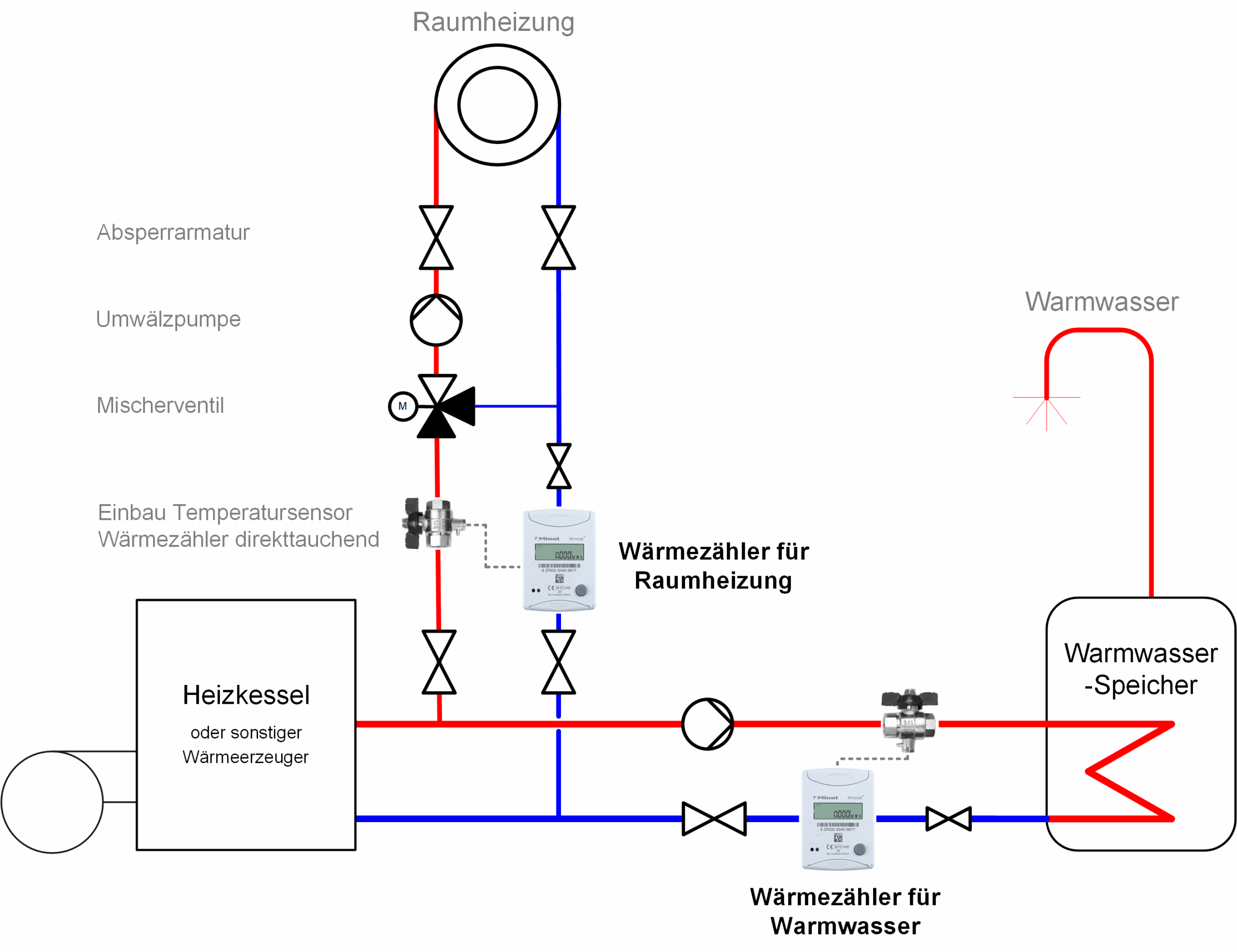
Figure: Schematic diagram for the installation of a heat meter to measure hot water heating, here with an additional heat meter for the heating circuit (Image: Minol)
Correctly determine the counter type and size
It may be necessary to install a Brunata Minol ultrasonic heat meter instead of a conventional heat meter. Brunata Minol recommends this type of meter if the heating water flow rate for domestic hot water cannot be precisely determined and/or the heating system uses a small plate heat exchanger with an instantaneous water heater principle and no connected storage tank, with a capacity of less than 10 kW. The reasons: Ultrasonic meters operate reliably even under overload conditions and can react quickly to sudden changes in heating water temperature, which are typical for small plate heat exchangers.
The most important questions and answers about the heat meter for hot water
Who installs heat meters?
Hire a qualified local professional to install your heat meter. Brunata Minol provides expert advice to tradespeople and heating engineers on device selection and installation. Brunata Minol offers a wide range of heat meters, from various volumetric measuring units and state-of-the-art electronic calculators to temperature sensors and all necessary mounting accessories.
When is the best time to install it?
The latest date for installing a heat meter was December 31, 2013. If you, as the building owner, had the installation carried out after this date, please inform the Brunata Minol billing service as soon as possible about the installation date, meter type, and initial reading so that the new heat meter can be integrated into the meter reading and billing service. The heat meter should ideally be installed at the start of the billing period for the building, and not just at some point during the year.
Who decides whether the installation effort is reasonable?
The building owner or owners' association makes the decision themselves. There is no government agency to assess this. An unreasonable burden exists if installing a heat meter necessitates a modification of the boiler and water heater. This is particularly the case with heating systems where the boiler and water heater are combined into a single, compact unit. The burden is considered reasonable if a heat meter can be installed by a qualified tradesperson in a typical manner and without major structural modifications.
What happens if the heat meter is missing?
The installation of heat meters is not monitored. Property managers and landlords can only obtain legally compliant billing if all regulatory requirements are met. It is currently impossible to predict how courts will rule in cases brought by individual apartment owners or tenants due to the absence of a heat meter for hot water. If no heat meter is installed, Brunata Minol will continue to use the calculation methods based on the measured amount of hot water consumed, as stipulated in Section 9, Paragraph 2 of the Heating Costs Ordinance. Furthermore, tenants have the right to reduce their heating costs if no heat meter is present (see below).
Who pays for the installation of the heat meter?
The installation of a heat meter for hot water is not listed in the inventory of chargeable items according to Section 7 Paragraph 2 of the Heating Costs Ordinance and is therefore not chargeable to the tenant. It is also not a modernization measure according to Section 559 of the German Civil Code (BGB) that could justify a rent increase. The landlord bears the costs of installing a heat meter for hot water.
Who pays the running costs of the heat meter?
The costs of reading and billing for heat meters – as well as the costs of rental and maintenance – are chargeable in accordance with Section 7 Paragraph 2 of the Heating Costs Ordinance and, unless otherwise requested, are automatically passed on to the users of the building as part of the Brunata Minol billing.
Do tenants have the right to a rent reduction if there is no heat meter for hot water?
Heat meters for hot water are a requirement of the Heating Costs Ordinance. The only sanction imposed by the legislature for non-compliance with the ordinance's requirements is the tenant's right to a reduction in their heating and hot water bill, according to Section 12 Paragraph 1 Sentence 1 of the Heating Costs Ordinance. This also applies here. The Federal Court of Justice (BGH) confirmed that tenants may reduce their heating and hot water bills by 15% if a heat meter for hot water is missing (BGH ruling of January 12, 2022 – VIII ZR 151/20). The Frankfurt Regional Court had previously ruled the same way (judgment of October 28, 2019 – 2-11 S 38/19).
Author

Quelle: Handbuch der Wärmekostenabrechnung | Frank Peters Minol Messtechnik W. Lehmann GmbH & Co. KG, 2019
 InsideCreativeHouse – Adobestock
Always up to date
* required fields